




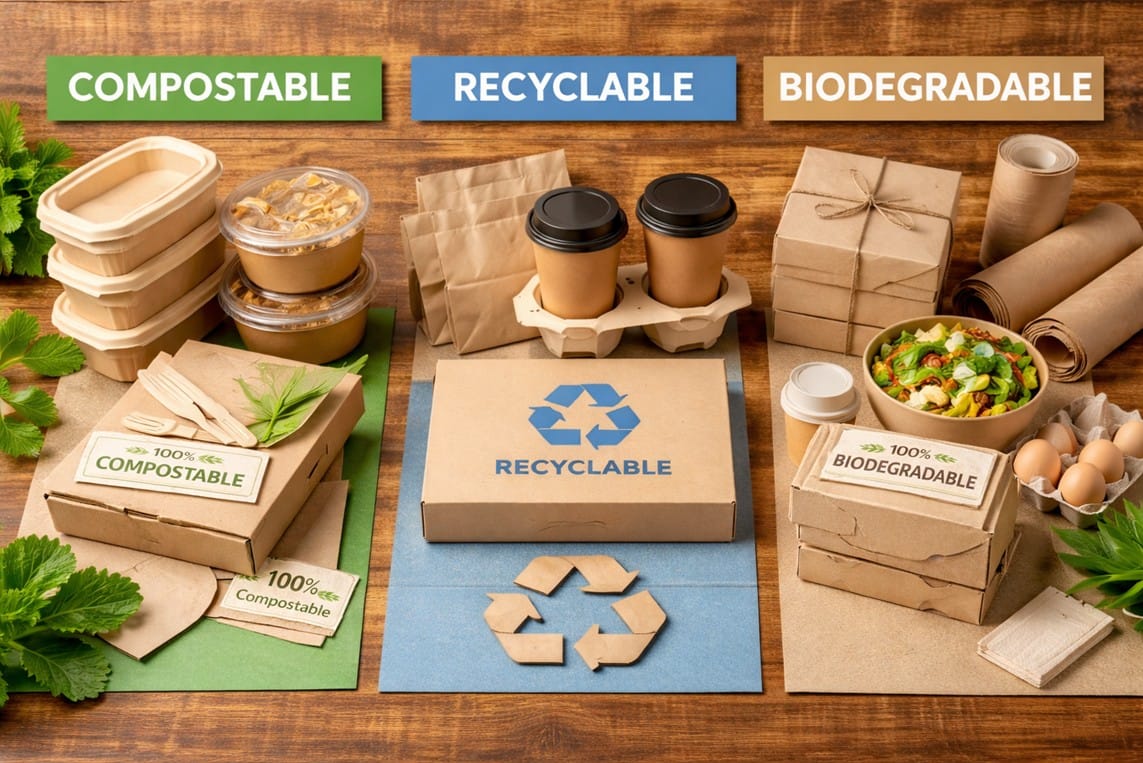
Sustainable packaging is a growing priority for Australian businesses. With increasing consumer demand and environmental regulations, choosing the right packaging solution is more important than ever.
However, terms like compostable, recyclable, and biodegradable packaging are often confused. While they sound similar, they refer to very different processes and disposal methods.
This guide explains the key differences and helps you choose the best sustainable packaging for your business.
Sustainability is now a key factor influencing purchasing decisions. Many consumers prefer brands that demonstrate environmental responsibility through packaging choices. Businesses that adopt sustainable packaging often strengthen their brand reputation while reducing waste.
Sustainable packaging can help businesses achieve several objectives.
Industries such as food service, takeaway, retail, and hospitality are increasingly transitioning to environmentally responsible packaging materials.
Businesses searching for reliable packaging solutions can explore the range of packaging products available through Elite Packaging’s products page where various takeaway containers, food packaging, and commercial packaging supplies are available.
Compostable packaging is designed to break down into natural organic material under composting conditions.
Key features:
Common compostable packaging materials include
Common compostable packaging materials include:
It’s important to understand that most compostable packaging is designed to break down in industrial composting facilities, where heat, moisture and microbial activity are carefully controlled. In standard landfill or home compost conditions, these materials may take much longer to decompose, or may not break down effectively at all.
Best for: takeaway containers, coffee cups, food trays, and cutlery
Recyclable packaging refers to materials that can be collected, processed, and reused to manufacture new products.
Key features:
Recyclable packaging is designed to be collected, processed and turned into new products, reducing reliance on virgin materials and keeping waste out of landfills.
Common recyclable materials include:
However, recycling only works when systems are used correctly. Contamination, especially from food residue can render materials unrecyclable, leading them straight to landfill.
Despite these challenges, recycling remains one of the most practical and accessible waste solutions for Australian food businesses today. With continued investment in infrastructure and advanced recycling technologies, the range of recyclable materials is expected to expand over time.
Businesses can browse the Elite Packaging packaging catalogue to review a variety of packaging products and materials suitable for commercial use.
Best for: paper bags, cartons, bottles, and dry food packaging
Biodegradable packaging refers to materials that break down naturally through microorganisms such as bacteria and fungi.
Key features:
Unlike compostable packaging, biodegradable materials do not require controlled composting conditions to break down, the process is often less predictable and can vary significantly.
Common biodegradable packaging materials include:
The rate of decomposition depends heavily on both the material composition and the surrounding environment (e.g. temperature, moisture and exposure to microorganisms). As a result, some products labelled “biodegradable” may still take months or even years to fully break down.
Best for: lightweight packaging and low-contamination items
Although these terms are often used interchangeably, they describe different environmental processes and disposal methods.
| Type | Breakdown | Disposal | Benefit | Best For |
| Compostable | Turns into organic compost | Industrial compost | Returns nutrients to soil | Hot food containers, coffee cups |
| Recyclable | Processed into new materials | Recycling systems | Reduces raw materials | Paper bags, cardboard |
| Biodegradable | Decomposes naturally | Environment dependent | Breaks down over time | Light wrapping, some serviettes |
Understanding these differences allows businesses to make informed packaging decisions that align with sustainability goals and operational needs.
Selecting the most appropriate packaging solution for your business is dependent on several practical factors including product type, local waste management infrastructure, and customer expectations.
Businesses should consider the following when evaluating packaging materials.
Many businesses adopt a combination of recyclable and compostable packaging depending on the products they sell.
Choosing the right packaging supplier also plays an important role in achieving sustainability goals. The Elite Packaging team can help you navigate material options, certifications and supplier compatibility — so you make the right choice the first time.
If you are looking for packaging solutions tailored to your operations, enquire with the Elite Packaging team today to discuss the best packaging options for your business.